How Garden Paintings Reveal Ideas About Cultivated Nature
See how garden paintings frame cultivated nature, and use their paths, boundaries and planting patterns to read design choices with greater care.
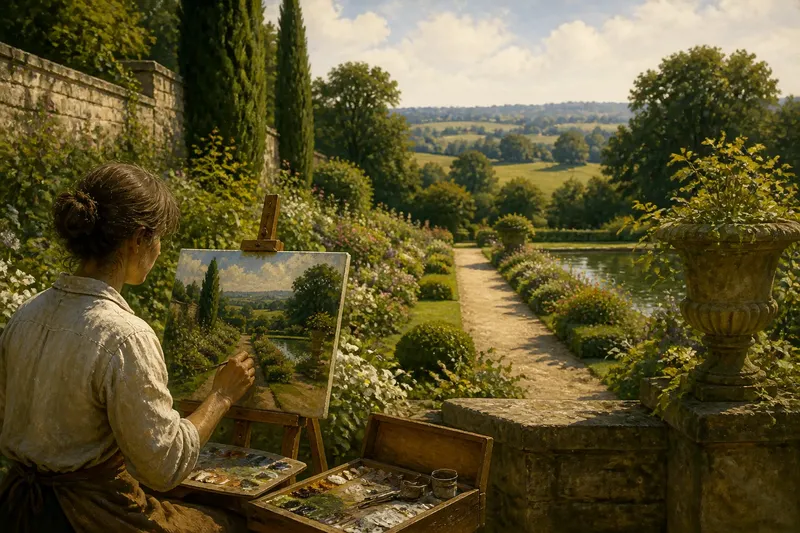
What can a garden painting tell you about how people shaped growing conditions? A clipped hedge, a terrace or an open lawn is not just scenery: it records choices about where plants should grow, how water and paths might be managed, and how cultivated ground should meet the land beyond.
A painting is not a planting plan, and its details may be idealised. Still, its visible arrangements can help you think more clearly about garden design: which spaces are enclosed, which are left open, and how repeated forms make a place feel orderly or natural. Treat those details as prompts for observation, not instructions to copy a vanished garden wholesale.
Read garden paintings for clues about cultivation
Begin with the ground itself. Look for level terraces, raised beds, lawns, paths, ponds and changes in slope. These features suggest how a garden’s layout directs movement and divides planting areas, though the image alone cannot tell you the soil conditions or the work needed to maintain them.
Then notice the planting pattern. A row of trees, a clipped hedge or a mass of flowers shows plants arranged to form a boundary, a screen or a visual focus. Irregular groups may appear less managed, but a deliberately composed picture can make careful cultivation look effortless.
For practical inspiration, translate the visual effect into a question about your own site. A painted avenue might prompt you to consider whether a clear line of sight would suit your garden; it does not mean that a row of trees belongs there. Check the available space, light, drainage and mature plant size before choosing anything to grow.
Boundaries show how gardens meet their surroundings
A wall, hedge or clipped edge makes the garden’s limits clear. It may also provide shelter, privacy or a surface for trained plants, but a painting cannot establish how well a particular boundary performs. In a real garden, observe wind exposure and shade before deciding whether a solid wall or a more permeable hedge fits the conditions.
Some scenes soften the boundary with lawns, scattered trees or a view across fields. That apparent ease can conceal substantial management: grass must be cut, trees placed with care and paths kept open. The image is useful because it shows the intended effect, not because it supplies a maintenance schedule.
Pay attention to what lies just beyond the boundary. A path continuing into the landscape or trees repeated across both sides can make the garden feel connected to its setting. That continuity can be recreated on a smaller scale through a view framed by planting, without pretending a small plot is an estate.
Paths and planting shape the experience of space
Follow the routes through the scene before trying to identify individual plants. A straight path draws the eye towards a destination; a curved one reveals the garden in stages. In a working garden, either choice affects how people move between beds and how easily tools or a watering can reach them.
Compare near and far planting. Dense foliage at the edge can frame a view, while low planting beside a path keeps a route visually open. These are useful design principles, but they must be adjusted to the plants’ eventual size and to the light available at ground level.
Imagine a gardener with a narrow, sunny strip beside a fence and a view of a neighbouring tree. They sketch a painted garden’s curved path, then check the strip’s width and notice that a path would leave little room for planting. Instead, they use a gently curving bed edge and place lower plants near the fence opening; the observable result is a softened route through the view without sacrificing most of the growing space.
Translate a painted effect into a sound garden choice
Use the painting to identify an effect, then decide whether the conditions in your garden can support it. A formal border, for instance, depends on plants that can be kept within a clear outline; a loose grouping needs enough room to retain its shape as plants grow.
- Observe whether the painted bed has a clear, repeated edge; if you want that effect and can maintain it, choose a defined border, otherwise use a looser planting line.
- Check whether the scene’s path is wide and direct; if your route must carry tools or a wheelbarrow, keep it practical, otherwise a narrower informal path may suit foot traffic.
- Notice whether trees are spaced as individual forms; if your site has room for their mature canopies, consider a small number, otherwise use shrubs or smaller plants to frame the view.
- Look for evidence of shade under trees or walls; if the intended bed receives limited sun, select plants suited to shade, otherwise consider sun-loving choices for a bright position.
- Check whether water appears in a pond or channel; if you can manage its upkeep and safety, explore a water feature, otherwise use a dry focal point such as a planted container.
- Observe whether the garden’s boundary is solid or permeable; if wind shelter or privacy is needed, consider a suitable hedge or screen, otherwise keep the edge open to preserve light and views.
- Notice whether beds appear densely planted; if you can provide the needed care and spacing, plan a fuller arrangement, otherwise leave room for plants to develop without crowding.
What is not worth the effort is guessing exact plant species from indistinct brushwork. The painting may show texture, height and grouping clearly enough; a confident name attached to a blurred leaf adds little to a cultivation decision.
What can a garden painting tell you?
Can a painting show how the garden was actually maintained?
It can show visible features such as paths, clipped edges or working figures, but it does not provide a full account of routine care. Treat signs of cultivation as clues and avoid assuming that every attractive surface required little work.
How can I use a painted layout in my own garden?
Borrow a principle, such as framing a view or making a route legible, rather than copying the whole design. Check your soil, light, drainage, available space and access before choosing plants or materials.
What does a hedge or wall suggest about growing conditions?
It may indicate an intended boundary or shelter, but the picture cannot tell you exactly how much shade or wind protection it provides. Observe those conditions on your own site before planting against a boundary.
Should I identify the plants in a garden painting?
Only when the image shows enough detail and the identification matters to your question. For cultivation, arrangement and growing conditions are often more useful than a speculative species name.
Keep the painting’s evidence separate from your decisions
Describe what you can see before deciding what it means. “A row of trees borders the path” is an observation; “the trees shelter the planting” is an inference that would need confirmation from the site itself. That distinction keeps visual inspiration from turning into unexamined advice.
The garden in a painted landscape can sharpen your eye for boundaries, planting structure and the relationship between a bed and its surroundings. Use those details to frame practical questions about your own soil, light, water and space. A picture can suggest what to look for; the garden itself supplies the answer.