What a Seed Uses Before Its First Leaf
What a seed uses before its first leaf depends on stored food, moisture and warmth; learn what to watch during germination and when to intervene.
What a seed uses before its first leaf is already packed inside it: stored food, water-sensitive tissues and an embryo poised to grow. For a gardener, the useful question is what to do while that reserve is being spent, before green leaves can supply energy by photosynthesis.
The answer is mostly restraint. Keep the seed’s conditions suitable, watch for the first sign of emergence and avoid treating every quiet pot as a problem. A seedling does not need feeding merely because it has not yet appeared above the compost.
Stored reserves fund the first stretch of growth
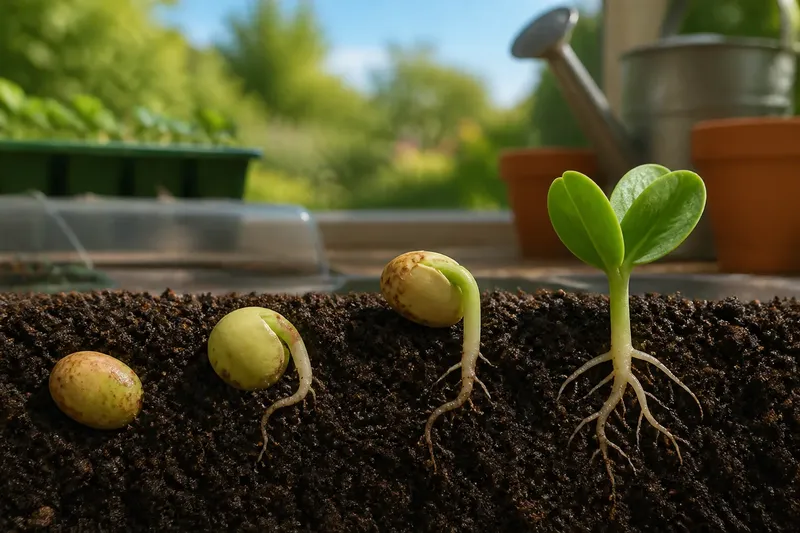
A seed contains an embryo, the young plant, and a food supply held in tissues such as the cotyledons or endosperm. The exact arrangement varies by plant. In a bean, the thick seed leaves store much of the food; in a cereal grain, the endosperm is a prominent reserve. The seed coat protects these parts until conditions permit growth.
Once germination begins, the embryo uses enzymes to make stored materials available. Sugars provide energy for cell activity, while other compounds supply materials for building new tissue. The first root, or radicle, usually emerges before the shoot. It anchors the seedling and begins taking up water and dissolved nutrients, but at this early stage the seed’s reserve remains central.
The cotyledons may stay below the soil or rise above it, depending on the species. They can continue to feed the young plant, and once exposed to light some cotyledons turn green and photosynthesise. The first true leaves are different in shape from the seed leaves and develop into the plant’s main leaf system. That transition is gradual rather than a switch flipped on the day a leaf opens.
Give the seed a steady week, not a daily rescue
A simple routine helps you respond to conditions instead of guessing at what is happening underground. Before sowing, check the seed packet for the recommended depth, temperature and germination conditions. These vary between plants, so a universal rule would be an efficient way to disappoint several species at once.
- At sowing: Use a clean pot or tray with drainage holes and fresh seed compost. Sow at the depth indicated for that seed; tiny seeds may need little or no covering, while larger ones are generally placed deeper.
- After sowing: Moisten the compost evenly. It should feel damp rather than waterlogged. A watering can with a fine rose, or gentle watering from below, can reduce the chance of washing seeds out of place.
- During the first few days: Keep the container in the temperature and light conditions the seed requires. Some seeds need light to germinate, while others are best covered. Do not assume a sunny windowsill suits every packet.
- As the surface begins to dry: Check the compost with a fingertip. Add water if it is drying, but do not keep pouring water into a pot that is already wet. A clear cover can slow drying, though it should be lifted or removed once shoots appear so air can circulate.
- When the shoot emerges: Move the container into bright light if it was covered or kept in darkness for germination. Keep the compost moist, not saturated, and make sure the young stem is not pressed against a lid.
- When the first true leaves open: Compare them with the cotyledons and begin following the plant’s usual seedling care. Feeding is generally not the first response; fresh compost and the plant’s own reserves may support early growth, but later needs depend on the species and growing medium.
Say you sow a broad bean in a small pot and keep it evenly moist in a suitable bright place. The seed coat softens, a root appears, and then the shoot lifts the cotyledons above the compost; you can observe the seed leaves opening before the first true leaves form. If the pot stays wet and the surface develops mould, the sensible response is to reduce excess moisture and improve airflow, not to add fertiliser.
Read the seedling’s timing before changing its care
Germination time is not a reliable measure of whether a seed is alive unless you account for the plant and its conditions. A cool room can slow a warmth-loving seed, while compost that dries around the seed can interrupt germination. Some seeds also need a particular treatment before sowing, such as chilling or soaking; the packet or supplier’s instructions are the practical reference.
If nothing has appeared by the expected period, check the surface gently rather than digging through the whole pot. Look for compost that is dry, sodden or compacted, and consider whether the container is in the right conditions. If you uncover a seed, replace the compost carefully and avoid repeatedly exposing it to air and light.
Once a seedling appears, a pale, stretched stem often points to insufficient light. A shoot that collapses at compost level can be associated with overly damp conditions and poor airflow. These are reasons to adjust the setting, not invitations to handle the seedling by its stem. If thinning is needed, snip unwanted seedlings at soil level rather than pulling them through a neighbour’s roots.
What should you expect before true leaves appear?
Do seeds need fertiliser before they sprout?
Usually, no. Before emergence, the embryo relies chiefly on the seed’s stored reserves, and fertiliser cannot compensate for unsuitable moisture or temperature. Follow the seed and compost guidance rather than adding feed by habit.
Why do cotyledons open before true leaves?
Cotyledons are the seed leaves, and they may provide or help access stored food as the seedling establishes. The true leaves develop afterwards and take on the familiar form of the plant’s foliage.
Should a seed tray stay covered after shoots appear?
A cover can help retain moisture during germination, but once shoots emerge it may trap excess humidity and restrict airflow. Remove it or vent it, while continuing to check that the compost does not dry out.
Can a seed germinate without light?
Some seeds germinate in darkness, while others need light or respond to it. Check the sowing instructions for the species rather than burying every seed to the same depth.
Know when leaving it alone is the better task
Not every seed requires close inspection. Constantly lifting the compost, changing the pot’s position and adding water at the first dry-looking patch can disturb the conditions more than it helps. A brief daily check of moisture and location is generally enough for a small tray; the seed itself does the less visible work.
There is also little value in judging a seedling by the size of its first leaves. Early growth is supported by the reserves assembled inside the seed, and different plants move through that phase at different paces. Keep notes of sowing date and conditions if you want to compare future attempts, but treat them as observations rather than a timetable every seed must obey.
What a seed uses before its first leaf is a temporary store, not a promise of indefinite growth. Once true leaves are expanding, provide suitable light and steady moisture, then shift to the plant’s normal care as it establishes. The small pause between sowing and greening is not empty time; it is the seedling building enough structure to begin paying its own energy bill.