The Pruning Calendar Myth
The pruning calendar myth gives way to a clearer choice: time each cut around flowering, fruiting, plant structure and the growth you want next.
When should you prune? The pruning calendar myth says there is one right season for every plant, but the better answer depends on what you want the plant to do next. A cut can encourage fresh shoots, preserve flowers, shape a young framework or remove growth that has already finished its job. The calendar matters, but the plant’s growth pattern matters more.
That is why a garden’s pruning jobs do not all belong on the same winter weekend. Before picking up secateurs, decide whether your priority is flowers, fruit, a manageable shape or a sound structure. Then identify where the plant puts its buds and when its useful growth happens. Those clues make timing a deliberate choice rather than a date copied from a general chart.
Choose the result before choosing the season
Pruning changes what remains available to grow. Shortening a shoot may prompt buds below the cut to produce new growth. Removing an entire branch can open the centre of a shrub, while cutting back a flowering stem at the wrong moment may remove buds formed for the coming display.
These effects make “prune in winter” an incomplete instruction. It can suit some deciduous shrubs and trees, especially when the aim is to see the branch structure clearly or encourage strong new shoots. It is less helpful as a rule for every flowering shrub, fruiting plant and evergreen in the garden.
Start by naming the desired result in plain terms: more flowers, a tidy outline, stronger young branches, less congestion or a harvest that is easier to reach. If there is no clear purpose, postponing a non-urgent cut is often better than pruning from habit. Plants do not require an annual haircut merely because the secateurs have been found.
Prune after flowering when the display comes first
Many spring-flowering shrubs form their flower buds on growth made during the previous growing season. If you cut that growth back before flowering, you may remove some of the display. For plants of this kind, pruning after the flowers fade lets the current show finish before you shape the shrub and allows the remaining branches to grow before the next flowering cycle.
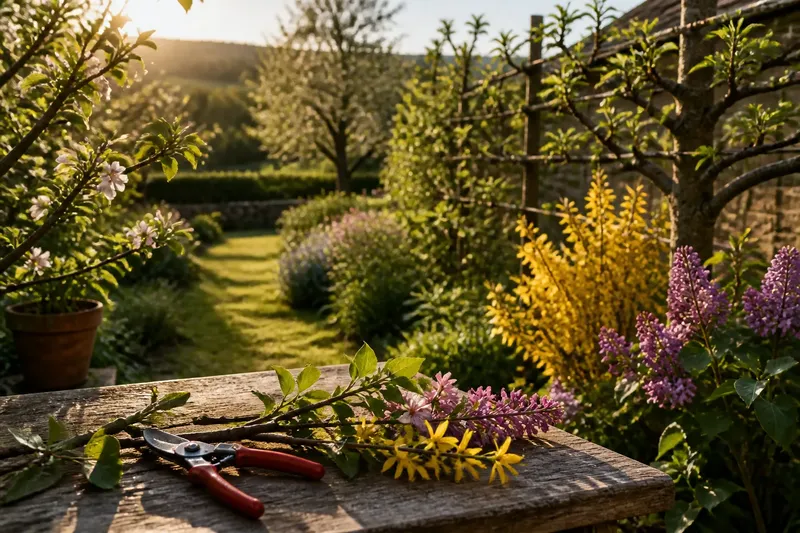
Forsythia and lilac are familiar examples, though the exact approach differs by plant and by the shape you want. A light trim may keep a shrub within its space; selective removal of older stems may encourage renewal from the base. Shearing the whole outline into a dense shell is a different choice: it produces a formal edge but can leave the centre crowded if used repeatedly.
This approach suits gardeners who value spring flowers and can accept that pruning follows, rather than precedes, the display. It also helps where a shrub has become congested: removing a few of the oldest stems near the base can admit light and make room for younger growth. Avoid cutting every stem to the same height unless that is genuinely the intended form.
Prune before active growth when structure matters
For some deciduous plants, dormant-season pruning makes the branching pattern easier to inspect. With leaves gone, crossing branches, damaged limbs and the plant’s basic framework are visible. A gardener shaping a young apple tree, for example, may use this quiet period to retain a balanced set of main branches and remove growth that competes with them.
This timing can also encourage vigorous shoots in spring, because the plant responds to cuts as growth resumes. That may be useful when a young shrub needs to fill out or when a framework needs new branches. It is not automatically useful for a mature plant already producing plenty of growth; more shoots can mean more congestion rather than a better shape.
Dormant pruning suits gardeners whose main aim is structure, access or controlled renewal, particularly when the plant is not being grown chiefly for an early display. It is less suitable as a blanket response to every bare branch. Some plants bleed sap heavily if cut at the wrong point in their cycle, and others flower on wood that would be removed. Check the plant’s identity and specific pruning guidance before making a substantial cut.
Use summer pruning to restrain or direct growth
Pruning during active growth generally has a different character from dormant pruning. Removing some leafy shoots can slow a plant’s expansion, improve access to fruit or keep a trained plant within its allotted space. The cut is not simply a smaller version of winter pruning: leaves are already feeding the plant, and the remaining growth continues to develop in the current season.
Fruit growers use summer pruning for certain trained apples and pears to manage new shoots and expose developing fruit to light. The method depends on the training system and the tree’s stage of growth. A freestanding tree left to develop its own form is not necessarily a candidate for the same treatment.
Summer pruning can suit a gardener trying to restrain vigorous growth or maintain a clear outline, especially where a plant is trained against a wall, fence or support. It may be a poor fit if the plant needs foliage to establish itself or if a large amount of growth would be removed during hot, dry conditions. Small, purposeful cuts are easier to judge than a sudden attempt to reduce the whole plant.
Match the approach to the plant and the gardener
Three broad approaches cover many ordinary decisions, though none replaces plant-specific guidance:
- After-flowering pruning: suited to shrubs that bloom on older growth and to gardeners who want to retain the current spring display. It makes sense when the flowers have finished and the plant can grow on before forming its next set of buds.
- Dormant-season pruning: suited to plants where a clear view of the branches helps with framework, selective thinning or renewal. It fits gardeners who want to shape structure before growth resumes, provided the plant’s flowering and sap habits allow it.
- Summer pruning: suited to trained fruit trees and some vigorous plants that need growth restrained or directed. It fits gardeners willing to make targeted cuts during the growing season, not those seeking one annual session for the whole garden.
Choose by asking what a cut is meant to change and what it might remove. A gardener focused on flowers should find out whether buds are carried on old or new wood. Someone focused on a young tree’s framework should inspect branch spacing and likely growth direction. Someone maintaining a trained fruit tree should follow the needs of that form rather than borrowing a schedule for an ornamental shrub.
Read buds, flowers and branches before cutting
Observation is more useful than a generic calendar. Note when the plant flowers, whether blooms appear on last year’s branches or on fresh shoots, and where new growth emerges. A label or a reliable plant-specific guide can help identify the relevant growth habit. For unfamiliar plants, a cautious delay is often preferable to a large, irreversible cut.
Say you have a lilac that flowers well but has grown too wide beside a path. If the aim is to keep the next spring display while reducing congestion, wait until flowering ends, then remove a few older stems from near the base rather than shearing the entire outer surface. The observable result to look for is a more open framework with younger stems left to develop, not an instantly compact shrub.
For a young apple tree, the decision may be different. If the aim is to build a useful framework, inspect the bare branches during dormancy and select the main limbs before making cuts. If the tree is already trained and producing vigorous shoots, summer pruning may be the more relevant approach. The plant’s form and purpose settle the question more reliably than the month alone.
Keep pruning tools suited to the cut
Clean, sharp secateurs suit small stems; loppers provide more leverage for thicker branches, while a pruning saw is intended for branches beyond the comfortable reach of hand tools. Choose a tool that cuts cleanly without forcing the handles. Ragged, crushed cuts and strained hands are both signs that the tool may be wrong for the job.
Make cuts with a clear destination in mind: above a suitable bud when shortening a shoot, or close to the branch collar when removing a branch. Do not cut flush against the trunk or leave a long stub. Large limbs, high work and branches near buildings, wires or public spaces are jobs for a qualified arborist rather than an improvised ladder arrangement. Follow tool instructions and local requirements where they apply.
What is not worth the effort is clipping every shrub into a uniform ball simply to make the garden look “done”. That can sacrifice flowers, create dense outer growth and make maintenance more frequent. A naturally layered shape may need less intervention and often gives a clearer view of the plant’s branching.
Which pruning time fits your aim?
When should spring-flowering shrubs be pruned?
Many are pruned after flowering because they often carry buds on growth made in the preceding season. Identify the shrub first, since flowering time and bud formation differ among plants.
Does dormant-season pruning always encourage more growth?
It can prompt vigorous shoots in some plants, but the response depends on the plant and the amount and location of the cuts. That extra growth may help renew a sparse framework or make a crowded plant harder to manage.
Can summer pruning reduce a fruit tree’s size?
It can help restrain or direct growth in certain trained fruit trees, but it is not a universal size-control method. The training form and the tree’s condition determine whether it is suitable.
What should a gardener do if the plant is unidentified?
Identify it before making substantial cuts, using its flowers, leaves, buds and growth habit. Until then, remove only clearly damaged or hazardous growth if it is safe to do so, and seek qualified help where a large branch or an uncertain risk is involved.
Let the plant’s cycle set the calendar
The pruning calendar myth fades once pruning is treated as a choice about future growth. After flowering preserves a display on older wood; dormant pruning can clarify structure and encourage renewal; summer pruning can restrain or direct active growth. None is the right answer for every plant.
For pruning timing, write down the plant’s flowering period and the result you want before choosing a day. That small note can prevent a well-meant cut from removing next season’s flowers, and it is a more useful garden record than a date that applies to everything except the plant in front of you.